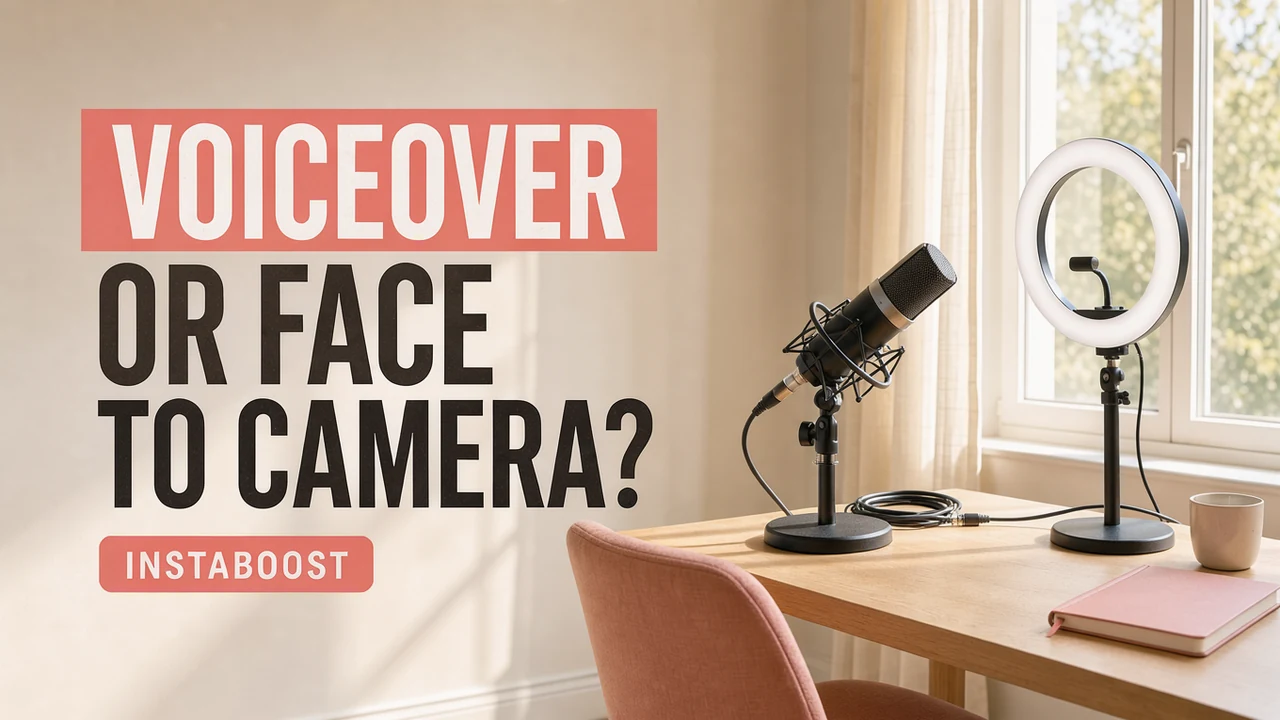
Each format does a different job. Here is how to choose, and the rules that apply if your voice — or your face — isn't really yours.
What TikTok actually rewards
Neither format has a bonus. TikTok's description of its For You feed names likes, shares, comments and whether people watch a video in full or skip it; sounds and hashtags count as information about the video. A face on screen isn't on the list, and neither is a voiceover.
So the useful question isn't "which format does TikTok prefer?" but "which format makes this video worth finishing?"
When face-to-camera works better
Showing your face works when you are part of the message:
- Opinions, reactions and stories. Viewers judge the person as much as the words. A face makes a claim feel owned.
- Building a recognizable account. People follow people. A face is the fastest way for a returning viewer to know it's you.
- Answering comments. Replying on camera to a viewer's question feels like a conversation, which is the point.
The cost: it takes more setup, and a weak first second is more visible when it's a face waiting to speak. Start mid-sentence, with the most interesting line.
When voiceover works better
A voiceover works when the thing on screen is the message:
- Tutorials and how-tos. Hands, a screen, a recipe, a repair — the viewer wants to see the process, not you.
- Before-and-after and reveals. The visual carries the hook; your voice explains it.
- Accounts that don't want a face. Plenty of creators stay off camera for privacy. A voice still gives the account a personality.
The cost: a voiceover over generic footage feels like a slideshow. The footage has to show something worth watching even with the sound off.
Voiceover, Creator Rewards and "original" content
If you want to earn from the Creator Rewards Program, the format matters less than the source. TikTok counts as original only content "filmed, designed, and produced entirely by yourself", and it lists what doesn't qualify, including:
- footage taken from other people, even with a filter, sped up or with new text;
- videos made only of photos or of text overlays;
- lip syncs, and copyrighted music playing for more than a minute.
A voiceover over your own footage is original. A voiceover over clips collected from other accounts isn't, however good the narration. And a face-to-camera video that is mostly lip sync doesn't qualify either.
AI voices and AI faces: the rules
Text-to-speech and AI voices make faceless videos easier, and TikTok has rules for them. Its help page on AI-generated content says:
- Creators must label all AI-generated content that contains realistic images, audio or video.
- Content where someone is shown "saying something they didn't say, for example, AI-generated speech" counts as significantly edited by AI.
- AI content showing the likeness of adult private figures without their permission, or of anyone under 18, isn't allowed at all, even with a label.
In practice: an obviously synthetic narrator voice over your own footage is fine; a realistic AI voice imitating a real person is not, and a realistic AI presenter needs the AI label. Unlabeled realistic AI content can be removed.
How to decide for your account
Don't pick one format forever. Test both on the same kind of video:
- Post two similar videos, one with you on camera and one as a voiceover.
- A few days later, open TikTok Studio → Analytics and compare average watch time and how many viewers finished each.
- Keep the format that holds people longer for that type of video — it may differ between your tutorials and your opinions.
Many accounts end up mixing: face-to-camera for the hook in the first seconds, voiceover for the part where the hands do the work.
What viewers see before they press play
Whatever the format, the first thing a visitor to your profile sees is the view count printed on each video's cover. A strong tutorial with a few dozen views tends to get skipped. TikTok views from INSTABOOST raise that number from the video's public link, with no password; they don't watch the video or improve its watch time, so the format still has to do its job. TikTok likes work the same way for the heart count. More for TikTok is on our TikTok page.
Questions about TikTok voiceovers
Do faceless TikTok videos get fewer views?
TikTok doesn't say so. It weighs how viewers react — watching in full, liking, sharing — and doesn't list showing a face among its signals.
Can a voiceover video earn in the Creator Rewards Program?
Yes, if the footage is your own. Voiceovers over other people's clips, photo slideshows or text-only videos don't count as original.
Do I have to label an AI voiceover on TikTok?
TikTok requires a label on AI-generated content that contains realistic audio or video. AI speech put in a real person's mouth counts as significantly edited by AI.
Is face-to-camera better for growing followers?
Often, because viewers follow people, but it depends on the video. Compare watch time for both formats on your own account.
Can I use someone else's voice with AI?
Not without permission. TikTok doesn't allow AI content using the likeness of private adults without their permission or of anyone under 18.

 Does Using One Sound Help You Grow on TikTok?
 How to Get More Views on TikTok Instantly: What Works
 TikTok Profile Views: Who Can See Them and What They Mean
 Free TikTok Likes, Followers and Views: What's Possible
 Are You Posting Too Much on TikTok? Here's How to Tell
 How to Get More Likes on TikTok Without Tricks
 How Long Can TikTok Videos Be? Limits for Every Format
 Do Filters and Effects Influence TikTok Viewer Retention?
 TikTok Creator Rewards Program: Requirements and Payouts
 Everyday Moments into TikTok Gold: How to Film Them
 Are TikTok Duets Still Worth Doing? When They Pay Off
 TikTok Hooks That Trigger Comments: How to Write Them